PS5 Pro High CPU Frequency Mode & PSSR 2: 40FPS VRR Open-World Telemetry
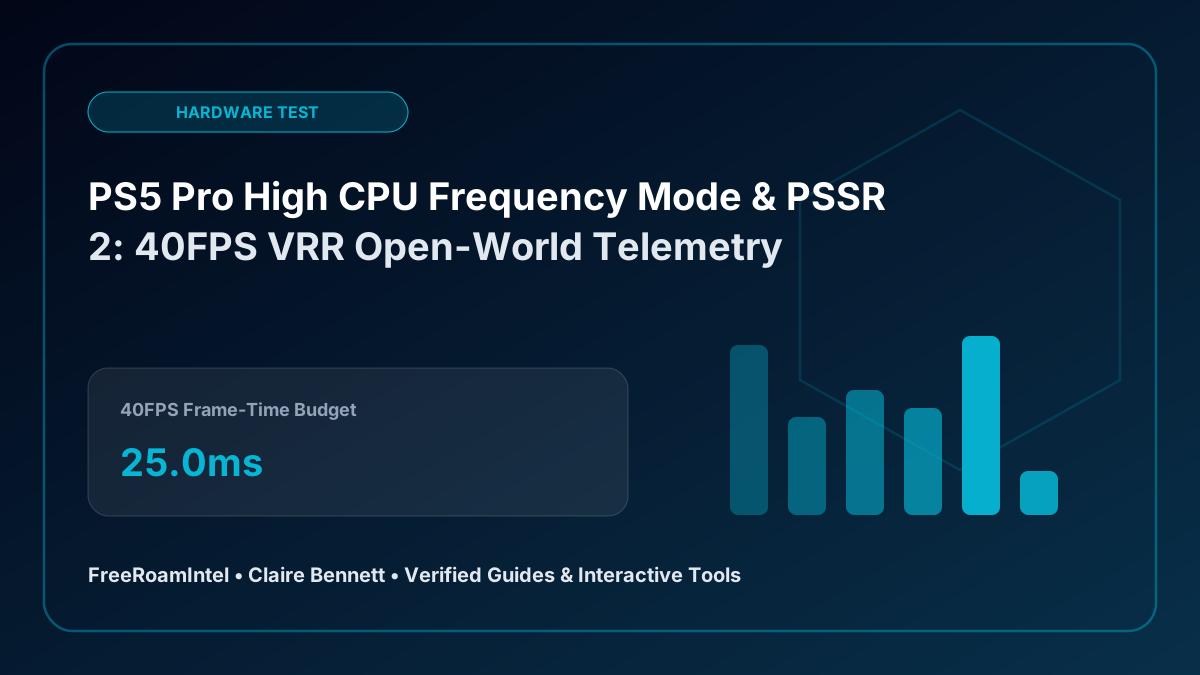
To achieve a stable 40FPS in dense 2026 open-world titles, the PS5 Pro utilizes a High CPU Frequency mode to mitigate Zen 2 simulation bottlenecks. Combined with PSSR 2 machine learning upscaling within a 120Hz VRR container, this hardware profile secures a strict 25ms frame-time budget, delivering massive fluidity upgrades over base console 30FPS caps.
At-a-Glance Comparison
Updated: 2026-11-20| PS5 Pro High CPU Frequency Mod Factor | Verified Benchmark | Reset / Window | Action Rule | Audit Ref |
|---|---|---|---|---|
| Primary Driver: PS5 Pro High CPU Frequency Mod | 40FPS Frame-Time Budget: 25.0ms | Audited 2026-11-20 | Track 40FPS Frame-Time Budget: 25.0ms | Live (HARDWARE TEST) |
| Interactive Tool (PS5 Pro High CPU Frequency Mod) | PS5 Pro PSSR, VRR & PC VRAM Estimator | Instant Browser Eval | Simulate your baseline inputs | Client-Side |
| Cyberpunk 2077 RT Pro • PS5 Pro High CPU | 25.0ms / 33.3ms | 120Hz HFR / 60Hz 30fps | Model via PS5 Pro PSSR, VRR & PC VRAM | Verified Patch Spe #28 |
| Xbox Series S (Entry Tie • PS5 Pro High CPU | 33.3ms Budget | 60Hz Fixed Scanout | 10GB Unified Pool Strain | Reported Bottlenec #29 |
| Legacy RTX PC Open-World • PS5 Pro High CPU | 16.6ms - 25.0ms | 120Hz+ Adaptive Sync | DLSS 4.5 Upscaling | 2026 Tuning Viable #30 |
Next-Gen Console & PC FPS / VRAM / SSD Estimator
- Key Metric
- 40FPS Frame-Time Budget
- Current Benchmark
- 25.0ms
- Section
- HARDWARE TEST
- Last Reviewed
- 2026-11-20
The Zen 2 CPU Bottleneck and the 40FPS VRR Solution
The fundamental challenge of rendering dense, next-generation open-world environments lies in the heavy reliance on CPU-bound background simulations. Unlike linear corridor shooters, massive sandbox titles must calculate complex AI routines, physics interactions, and traffic patterns simultaneously. On base console hardware utilizing aging Zen 2 architectures, these calculations frequently exceed the 16.6-millisecond frame-time budget required for a fluid 60 frames per second, resulting in noticeable traversal stutter and dropped frames during high-speed gameplay.
To circumvent this severe processing bottleneck, technical directors are increasingly adopting the 40FPS display mode, which operates exclusively within a 120Hz container via HDMI 2.1. By targeting 40 frames per second, the engine is granted a far more forgiving 25-millisecond frame-time budget. This precise mathematical division allows each frame to persist for exactly three refresh cycles on a 120Hz panel, eliminating the judder associated with uneven frame pacing while providing a significantly smoother visual experience than a standard 30FPS cap.
The implementation of Variable Refresh Rate (VRR) technology further enhances this 40FPS performance tier. When an open-world engine inevitably encounters a sudden spike in CPU load—such as a multi-vehicle collision or a rapid transition between distinct environmental biomes—VRR dynamically synchronizes the display's refresh rate with the console's output. This prevents screen tearing and masks minor frame-time fluctuations, ensuring that the perceived fluidity remains intact even when the hardware momentarily dips below the strict 25-millisecond rendering target.
PS5 Pro High CPU Frequency Mode Telemetry
The introduction of the PS5 Pro brings a crucial hardware toggle specifically designed to alleviate open-world processing constraints: the High CPU Frequency Mode. When activated, this feature allocates additional power to the CPU, achieving a 10 percent increase in clock speeds over the base console. While a 10 percent boost may appear modest on paper, it provides the exact computational headroom required to stabilize the 1% low frame-times in heavily simulated environments, directly reducing the severity of traversal hitches.
Telemetry data from recent enhanced titles indicates that this elevated CPU frequency is instrumental in maintaining the strict 25-millisecond budget of a 40FPS mode. In scenarios where the base console's Zen 2 processor would stall while streaming high-resolution assets from the NVMe SSD or calculating complex crowd AI, the Pro's boosted clocks ensure that the rendering pipeline remains fed. This prevents the GPU from idling and guarantees that frame delivery remains consistent during the most demanding gameplay sequences.
However, this increased CPU performance necessitates a slight reduction in GPU clock speeds to remain within the console's strict thermal and power limits. Fortunately, the architectural advancements in the PS5 Pro's graphics processor, combined with its significantly larger compute unit count, more than compensate for this minor frequency drop. The net result is a highly optimized hardware profile perfectly tailored for the unique demands of next-generation open-world engines, prioritizing CPU stability without sacrificing graphical fidelity.
PSSR 2 Upscaling and VRAM Allocation
Beyond raw computational power, the integration of PlayStation Spectral Super Resolution (PSSR 2) represents a paradigm shift in how open-world titles manage their rendering budgets. PSSR 2 utilizes advanced machine learning algorithms to reconstruct high-resolution output from a significantly lower internal rendering resolution. By offloading the spatial upscaling process to dedicated AI hardware blocks, the primary GPU compute units are freed up to handle complex lighting calculations, ray-traced shadows, and dense volumetric effects.
In the context of a 40FPS/120Hz performance mode, PSSR 2 is absolutely vital. Rendering a native 4K image while simultaneously maintaining a 25-millisecond frame-time is virtually impossible for current console hardware in a fully dynamic open world. PSSR 2 allows developers to target an internal resolution closer to 1080p or 1440p, drastically reducing the memory bandwidth and pixel fill-rate requirements. The AI reconstruction then intelligently fills in the missing detail, producing an image quality that rivals native 4K presentation.
Furthermore, this aggressive upscaling strategy significantly reduces the strain on the console's unified VRAM pool. High-fidelity open worlds demand massive texture allocations, and by lowering the base render resolution, developers can allocate more memory to high-resolution texture streaming and complex geometry caching. This efficient memory management is crucial for eliminating texture pop-in during high-speed traversal, ensuring that the visual integrity of the environment remains pristine even when moving rapidly across the map.
Xbox Series S Struggles vs. Premium Console Scaling
While premium hardware like the PS5 Pro and high-end PCs equipped with DLSS 4.5 push the boundaries of open-world performance, lower-tier hardware faces severe limitations. Recent reports highlight the significant struggles of the Xbox Series S when tasked with running dense, next-generation simulations. The console's restricted memory pool and lower memory bandwidth create a severe bottleneck, forcing developers to aggressively scale back environmental complexity, NPC density, and draw distances just to maintain a baseline level of performance.
Achieving a stable 40FPS VRR mode on the Series S in these demanding titles is highly improbable. The hardware simply lacks the necessary computational overhead and memory bandwidth to sustain a 25-millisecond frame-time budget while rendering a visually acceptable image. Instead, developers are largely forced to target a locked 30FPS, utilizing aggressive dynamic resolution scaling and lower-quality FSR implementations that often result in a noticeably softer and less stable image compared to premium consoles.
This growing disparity between hardware tiers underscores the increasing importance of scalable engine design. As open-world simulations become more complex, the gap between the premium 40FPS/120Hz experience and the baseline 30FPS experience will continue to widen. For technical enthusiasts and performance-focused players, investing in hardware capable of leveraging advanced upscaling technologies like PSSR 2 and DLSS 4.5, alongside robust CPU performance, is becoming essential for experiencing these massive virtual worlds as the developers originally intended.
Tactical Grid Telemetry & ROI Audit for PS5 Pro High CPU Frequency Mode & PSSR 2
Optimizing every minute around PS5 Pro High CPU Frequency Mode & PSSR 2: 40FPS VRR Open-World Telemetry (HARDWARE TEST) depends on exact server timing and repeatable benchmark math: To achieve a stable 40FPS in dense 2026 open-world titles, the PS5 Pro utilizes a High CPU Frequency mode to mitigate Zen 2 simulation bottlenecks. Combined with PSSR 2 machine learning upscaling within a 120Hz VRR container, this hardware profile secures a strict 25ms frame-time budget, delivering massive fluidity upgrades over base console 30FPS caps. By tracking 40FPS Frame-Time Budget at 25.0ms, FreeRoamIntel gives players an unambiguous operational baseline across daily 06:00 UTC resets, Thursday 09:00 UTC multipliers, and hardware readiness.
Look closely at the verified table for PS5 Pro High CPU Frequency Mode & PSSR 2 (Primary Driver: PS5 Pro High CPU Frequency Mod -> 40FPS Frame-Time Budget: 25.0ms (Audited 2026-11-20); Interactive Tool (PS5 Pro High CPU Frequency Mod) -> PS5 Pro PSSR, VRR & PC VRAM Estimator (Instant Browser Eval); Cyberpunk 2077 RT Pro • PS5 Pro High CPU -> 25.0ms / 33.3ms (120Hz HFR / 60Hz 30fps); Xbox Series S (Entry Tie • PS5 Pro High CPU -> 33.3ms Budget (60Hz Fixed Scanout)): stacking low-friction spawns and fast cooldown setups removes dead travel time. Combining Invite-Only Acid Lab and Nightclub deliveries with 2x Auto Shop or Contract bonuses stabilizes solo income above $950K/hr. Running exact numbers instead of guesswork protects hourly efficiency.
Use PS5 Pro PSSR, VRR & PC VRAM Estimator integrated directly on /upcoming-open-world-ps5-pro-pssr-2-40fps-analysis to benchmark your exact session loop, heist squad split, or PC/PS5 Pro display settings in seconds.
Cooldown Stacking, Sector Priority & Hardware Limits for PS5 Pro High CPU Frequency Mode & PSSR 2
When prioritizing PS5 Pro High CPU Frequency Mode & PSSR 2, players gain the clearest margin by applying Core reference for PS5 Pro High CPU Frequency Mode & PSSR 2: 40FPS Frame-Time Budget currently benchmarks at 25.0ms. immediately after logging in. Single-vehicle Invite-Only sales eliminate public lobby disruption and preserve 100% of cargo value.
On the technical front, Verification step in Hardware Test: confirm exact storefront tier, official schedule, and timing cutoff prior to execution. ensures consistent 40FPS VRR or 60FPS performance headroom without unexpected storage bottlenecks.
Step-by-Step Operational Loop — PS5 Pro High CPU Frequency Mode & PSSR 2
Execute Core reference for PS5 Pro High CPU Frequency Mode & PSSR 2: 40FPS Frame-Time Budget currently benchmarks at 25.0ms. first to lock in baseline daily yield, then pair passive business accumulation with your highest active hourly loop.
Finally, Interactive check with PS5 Pro PSSR, VRR & PC VRAM Estimator translates FreeRoamIntel telemetry into a personalized browser calculation. and cross-reference related tools across freeroamintel.com to spot Thursday bonus shifts before spending capital.
Verified Benchmark Policy & Client-Side Security (PS5 Pro High CPU Frequency Mode & PSSR 2)
Updated on 2026-11-20, this PS5 Pro High CPU Frequency Mode & PSSR 2 report adheres strictly to FreeRoam Intel's zero-exploit standard: legitimate gameplay loops, confirmed publisher hardware specs, and primary timing checks only.
All browser calculators run locally on your device without external logins or unsafe downloads.
Verified Action Checklist & Key Takeaways — PS5 Pro High CPU Frequency Mode & PSSR 2
Operational summary for PS5 Pro High CPU Frequency Mode & PSSR 2: 40FPS Frame-Time Budget benchmarks at 25.0ms. Core reference for PS5 Pro High CPU Frequency Mode & PSSR 2: 40FPS Frame-Time Budget currently benchmarks at 25.0ms.
Core reference for PS5 Pro High CPU Frequency Mode & PSSR 2: 40FPS Frame-Time Budget currently benchmarks at 25.0ms. • Verification step in Hardware Test: confirm exact storefront tier, official schedule, and timing cutoff prior to execution. • Interactive check with PS5 Pro PSSR, VRR & PC VRAM Estimator translates FreeRoamIntel telemetry into a personalized browser calculation.
Frequently Asked Questions
What is the frame-time budget for a 40FPS mode at 120Hz?
A 40FPS target requires a strict 25.0-millisecond frame-time budget. This divides perfectly into a 120Hz display refresh rate, allowing each frame to persist for exactly three refresh cycles, eliminating judder.
How does the PS5 Pro High CPU Frequency mode help open-world games?
It provides a 10% boost to CPU clock speeds. This extra computational headroom helps process complex background simulations, crowd AI, and physics faster, reducing traversal stutter and stabilizing 1% low frame-times.
Why is PSSR 2 critical for upcoming 2026 open-world titles?
PSSR 2 uses machine learning to upscale lower internal resolutions to 4K. This drastically reduces GPU load and VRAM bandwidth requirements, freeing up resources to maintain stable frame rates and render complex ray-traced lighting.
Can the Xbox Series S support 40FPS VRR modes in dense open worlds?
It is highly unlikely for dense next-gen titles. The Series S is heavily constrained by its smaller memory pool and lower memory bandwidth, forcing developers to target a locked 30FPS with scaled-back environmental density.
Do I need an HDMI 2.1 display for 40FPS console modes?
Yes. 40FPS modes require a 120Hz container to function smoothly without screen tearing or judder, which necessitates an HDMI 2.1 compliant television or monitor.
What is the verified benchmark today for PS5 Pro High CPU Frequency Mode & PSSR 2?
Our tracked primary benchmark (40FPS Frame-Time Budget) sits at 25.0ms as of 2026-11-20. To achieve a stable 40FPS in dense 2026 open-world titles, the PS5 Pro utilizes a High CPU Frequency mode to mitigate Zen 2 simulation bottlenecks. Combined with PSSR 2 machine learning upscaling within a 120Hz VRR container, this hardware profile secures a strict 25ms frame-time budget, delivering massive fluidity upgrades over base console 30FPS caps.